Status note: This guide reflects the Regulation of Artificial Intelligence Bill 2026 as initiated and the European Union Artificial Intelligence Designation Regulations 2025. The Bill may change during the legislative process, but is currently expected to be accepted by 2nd August 2026. This article provides general information intended to give an overview of the AI regulation landscape and is not legal advice.
How is AI regulated in Ireland?
The EU Artificial Intelligence Act applies directly in Ireland. Ireland must establish the national authorities, enforcement procedures, penalties and coordination arrangements needed to make the legislation work. The Regulation of Artificial Intelligence Bill 2026 is intended to provide this domestic enforcement structure. At the time of writing in July 2026, the Bill is before Seanad Éireann and it is expected to be agreed in time for the deadline of August 2nd 2026. The bill proposes the formation of a new AI Office to be known as Oifig IS na hÉireann (AI Office of Ireland). Oifig IS na hÉireann will coordinate Ireland’s designated authorities which will have investigative, enforcement and sanctioning powers. Information online often references both 15 Irish AI authorities and 13 Irish AI authorities. Both figures are correct: Ireland has designated 15 competent authorities under the EU AI Act, but only 13 of these are market surveillance authorities responsible for sectoral supervision and enforcement. The remaining two are the Minister for Enterprise, Tourism and Employment and the Minister for Transport, which perform specific national competent and notifying-authority functions rather than acting as market surveillance authorities. Ireland has chosen a distributed model which uses the 13 market surveillance authorities to supervise AI within the sectors and legal areas they already understand. Oifig IS na hÉireann will coordinate them rather than replacing them.
How the Irish system fits together
Under the regulation of AI Bill 2026, Ireland’s model has a four-layer governance and enforcement structure. The EU AI Act provides the legal framework. In Ireland, the Minister for Enterprise, Tourism and Employment is responsible for appointments, funding and limited policy direction in relation to Oifig IS na hÉireann. The Office coordinates the national system, while 13 designated market surveillance authorities supervise and enforce the AI Act within their respective sectors. The figure of 13 refers specifically to Ireland’s designated market surveillance authorities. The wider competent-authority framework also includes the Minister for Enterprise, Tourism and Employment and the Minister for Transport in particular national competent or notifying-authority roles. Some market surveillance authorities, including HPRA and ComReg, also perform notifying functions connected with conformity-assessment bodies. The image below shows this simplified structure as a coordination map, rather than a strict chain of command.
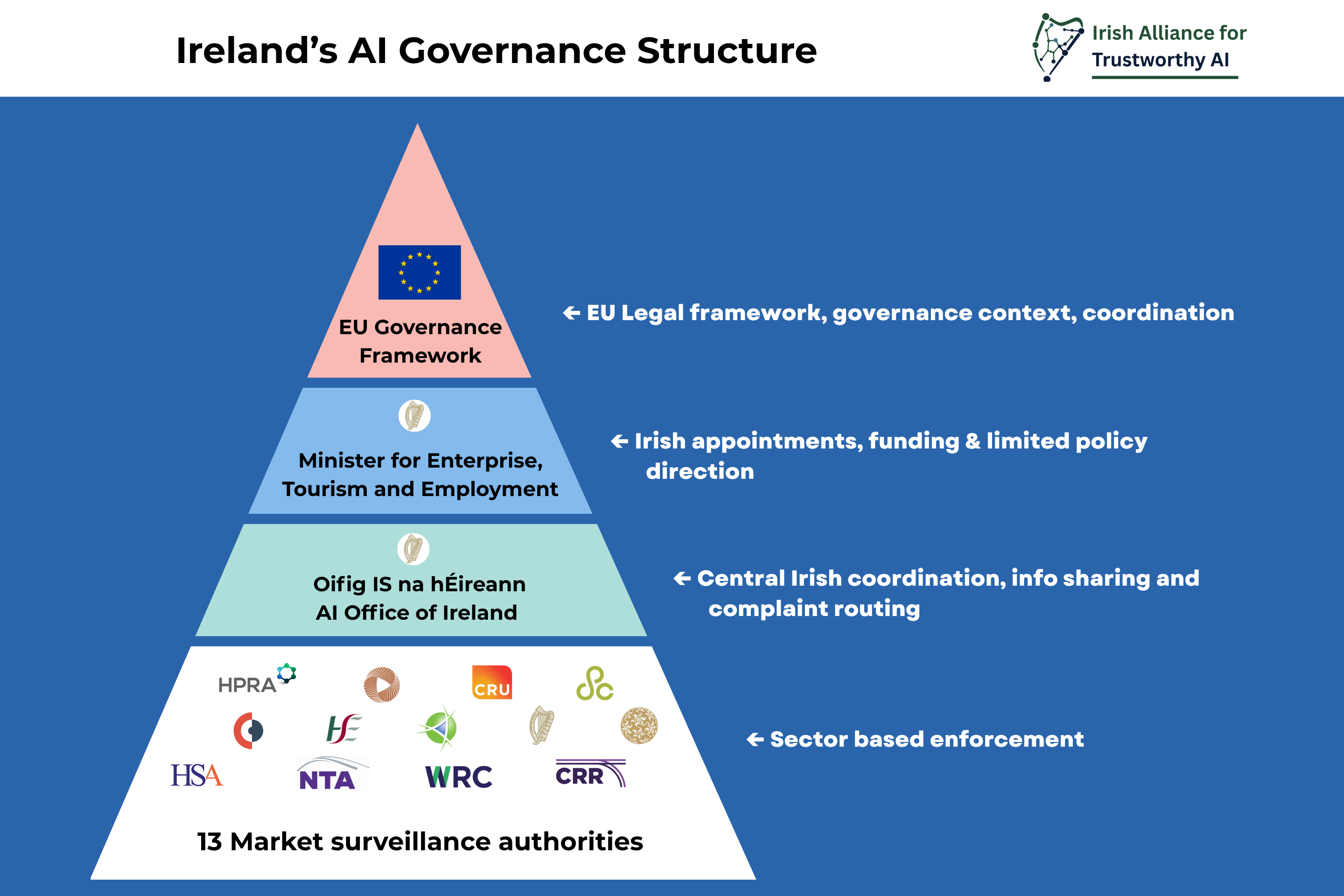
The diagram shows the core statutory structure only. Adjudicators, the courts, the Oireachtas, fundamental-rights bodies, the AI Advisory Council, NSAI and INAB sit alongside this structure which we explain later in this article.
EU AI Act and European AI Office
The EU AI Act is the world's first comprehensive law regulating Artificial Intelligence. It aims to regulate AI for the purpose of the protection of fundamental rights. It sorts AI tools by risk level. High-risk tools, like those used in hiring or healthcare, need strict testing and human oversight. Banned tools include government social scoring, certain surveillance monitoring, and manipulation of vulnerable groups. It also sets clear rules for trust and safety, in particular for use cases most likely to affect fundamental rights, for example when being used to determine access to education, healthcare risk evaluation, and areas relating to employment rights.
The EU AI Act entered into force on 1 August 2024, but its requirements apply in stages. Prohibited AI practices and AI-literacy duties began applying in February 2025. Governance rules and obligations for providers of general-purpose AI models began applying in August 2025. In June 2026, the Council of the European Union approved new extended dates for the principal high-risk AI requirements. The main high-risk requirements will apply from 2 December 2027 for stand-alone high-risk systems and from 2 August 2028 for high-risk systems embedded in regulated products. The national regulatory-sandbox deadline has been moved to 2 August 2027. The delay gives Ireland additional time to build regulatory expertise, establish cooperation procedures and create understandable complaint routes. It should not be treated as a reason to delay the development of the governance system itself.
The European AI Office sits within the European Commission. It supports the implementation of the AI Act across the European Union and directly supervises important obligations applying to general-purpose AI models. The wider European structure also includes the European Artificial Intelligence Board, the Scientific Panel and the Advisory Forum. National authorities remain responsible for most supervision of AI systems used within particular sectors. The European AI Office and the AI Office of Ireland are separate organisations. The European Office performs EU-level functions. The Irish Office will coordinate Ireland’s national authorities.
The Department of Enterprise, Tourism and Employment has been the lead government department for Ireland’s implementation of the EU AI Act to date. It developed the implementation roadmap, sponsored the Regulation of Artificial Intelligence Bill and has responsibility for the wider policy environment surrounding enterprise adoption, AI innovation and regulation. The Department sets government policy and the Minister for Enterprise, Tourism and Employment is responsible for appointments and funding for the new AI Office of Ireland. It was argued in the Seanad in multiple debates in July 2026 that enterprise is over prioritised in the Regulation of the AI bill. The proposed AI Office is intended to perform independent statutory and coordinating functions. Keeping those roles sufficiently separate will be important for public confidence. The Department of the Taoiseach also has an important policy role through Ireland’s National Digital and AI Strategy, which covers AI adoption, public services, infrastructure, skills, investment and public trust.
The AI Office of Ireland
The AI Office of Ireland, or Oifig IS na hÉireann, is intended to become the central coordinating body for AI regulation in Ireland. The Regulation of Artificial Intelligence Bill describes it as an independent statutory body. Its proposed functions include coordinating market surveillance authorities, serving as Ireland’s single point of contact under the AI Act, providing access to technical expertise and supporting consistent implementation of the legislation. The Office will also operate Ireland’s focal point for AI regulation, innovation and adoption. This includes establishing AI regulatory sandboxes to allow innovators to develop and test certain AI systems under regulatory supervision before wider deployment. The Office will also maintain a national AI register and establish a cooperation forum for authorities responsible for supervising and enforcing the AI Act.
The AI Office should not be understood as the sole Irish AI regulator. A complaint involving personal data may still belong with the Data Protection Commission. An employment system may fall under the Workplace Relations Commission. A medical AI product may be supervised by the Health Products Regulatory Authority. The Irish model will depend heavily on whether the AI Office can prevent people and businesses from being passed between multiple regulators.
Ireland’s 13 AI Market Surveillance Authorities
Ireland has designated 13 market surveillance authorities under the EU AI Act. Together, they form the country's principal AI enforcement network, while Oifig IS na hÉireann coordinates their activities and promotes consistent implementation across sectors. Each authority is responsible for supervising AI within its existing area of expertise, such as financial services, healthcare, transport or communications. Most organisations will therefore interact with only one regulator, depending on the sector in which their AI system is developed, placed on the market, deployed or used. The 13 authorities do not all use the same enforcement procedure. As the diagram below shows, eleven follow the common investigation, adjudication and administrative-fine route established by the Bill, while the Central Bank of Ireland and the Competition and Consumer Protection Commission use separate statutory procedures. The Central Bank applies its adapted financial-services enforcement framework, while the CCPC uses a separate AI enforcement procedure inserted into the Competition and Consumer Protection Act 2014.
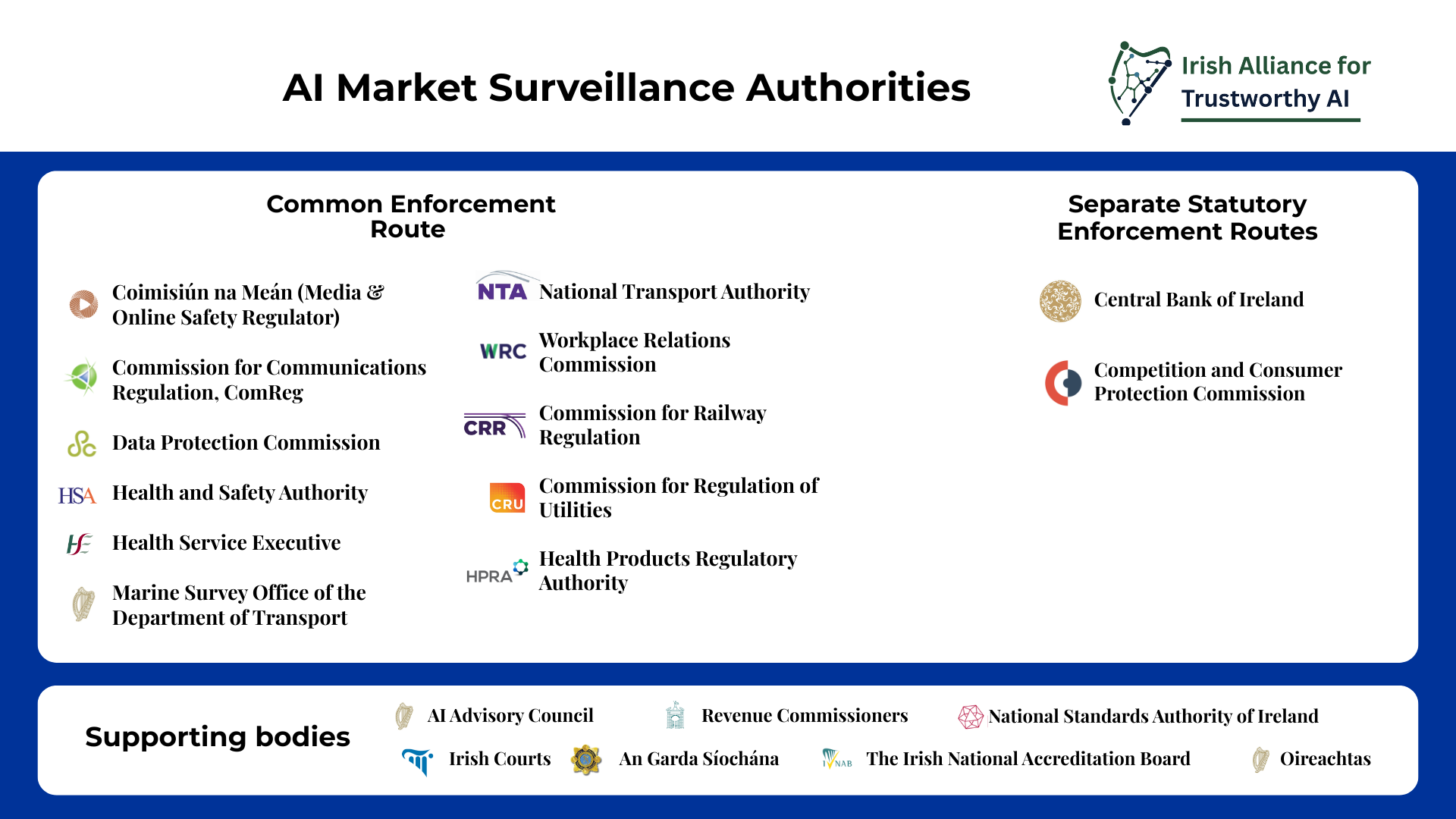
The 13 market surveillance authorities can be grouped into four categories. The following categories are used here to make the network easier to understand. They are not formal statutory classifications.
Digital, Data, Employment and Consumer covers AI used in digital services, online platforms, communications, data processing, employment and consumer-facing products and services.
Financial Services covers AI used in banking, financial services and regulated financial markets. The Central Bank of Ireland and the Competition and Consumer Protection Commission follow separate statutory enforcement procedures, while the remaining 11 authorities use the common enforcement procedure established by the Bill.
Transport and Infrastructure covers AI used in transport systems, utilities, public infrastructure and other critical services.
Health and Life Sciences covers AI used in healthcare delivery, medical devices, medicines, occupational health and workplace safety.
Which Irish authority may regulate an AI system?
This table is prepared as a guide rather than a definitive allocation of legal jurisdiction. Responsibility will depend on the system’s intended purpose, the sector in which it is used, whether it is incorporated into a regulated product and the particular legal issue involved. A single AI system may fall within the remit of more than one authority.
Rights, Advice And Democratic Scrutiny
The AI Advisory Council
The AI Advisory Council is a non-statutory expert advisory body established by Government. It is not a regulator and cannot investigate complaints or impose penalties. The Council provides advice on emerging AI issues, develops its own policy recommendations and participates in public communication about trustworthy, ethical and person-centred AI. It is chaired by Dr Patricia Scanlon, who previously served as Ireland’s first AI Ambassador. Its membership includes representatives from academia, technology, law, business, security, social science, economics and civil society. Under Dr Scanlon’s chairmanship, the Council has addressed AI skills and employment, education, support for Irish businesses, infrastructure and sovereignty, facial-recognition technology and the effect of generative AI on the creative sector. Scanlon has framed the challenge as one of keeping Ireland competitive while building an inclusive, ethical and sustainable approach to AI.
The Oireachtas and democratic scrutiny
The Oireachtas has two important roles. The Regulation of Artificial Intelligence Bill is being examined through the normal legislative process in the Dáil and Seanad. Separately, the Joint Committee on Artificial Intelligence examines the development, use, regulation and societal effects of AI. The Dáil debates of 24 and 30 June 2026 and the Seanad debates of 1 and 9 July showed broad support for establishing Ireland’s AI regulatory institutions. However, they also exposed disagreements about the independence of the AI Office, ministerial powers, board appointments, human-rights expertise, civil-society representation and accountability to the Oireachtas. These debates matter because an AI regulator’s independence is determined not only by its statutory title, but also by how its leadership is appointed, how it is funded, whether ministers can influence its priorities and whether it can speak openly about weaknesses in government policy.
Fundamental-rights bodies
The Bill identifies nine public bodies that may become involved where the use of a high-risk AI system could infringe rights protected by EU law. These are, An Coimisiún Toghcháin, Coimisiún na Meán, the Data Protection Commission, the Environmental Protection Agency, the Financial Services and Pensions Ombudsman, the Irish Human Rights and Equality Commission, the Ombudsman, the Ombudsman for Children and the Ombudsman for the Defence Forces. They are not additional market surveillance authorities, but may seek access to relevant documentation and request that the appropriate authority organise testing where necessary. The Bill also permits market surveillance authorities to enter formal cooperation agreements with bodies including Oifig IS na hÉireann, relevant fundamental-rights bodies, the Commission for Aviation Regulation, INAB, An Garda Síochána and the Revenue Commissioners. These bodies may support cooperation and information sharing but are not additional market surveillance authorities.
The Irish Alliance for Trustworthy AI and civic participation
The Irish Alliance for Trustworthy AI sits outside Ireland’s formal regulatory and enforcement structure. It is a civic alliance of people and organisations working to ensure that AI is developed and used responsibly, inclusively and in the public interest. Its focus is on bringing wider Irish voices into decisions about AI, particularly in relation to democracy, culture, public capability, community participation and the common good.
The Alliance is not one of Ireland’s 13 market surveillance authorities and does not investigate complaints, impose penalties, certify AI systems or accredit conformity-assessment bodies. Instead, it complements the statutory framework by supporting civic participation, public discussion and practical engagement with trustworthy AI. In broad terms, Oifig IS na hÉireann coordinates the regulatory system, the designated authorities supervise and enforce the law, the AI Advisory Council advises Government, NSAI and INAB support standards and accreditation, and the Alliance brings civil-society and public-interest perspectives into the wider debate.
How AI enforcement works in Ireland
The Regulation of Artificial Intelligence Bill creates three administrative enforcement routes. The route used depends on which market surveillance authority is responsible for the AI system. Eleven authorities use the Bill’s common investigation and adjudication procedure, while the Central Bank of Ireland and the Competition and Consumer Protection Commission use separate statutory procedures.
The common enforcement route for 11 authorities
For 11 of Ireland’s 13 market surveillance authorities, an authorised officer conducts the investigation on behalf of the relevant regulator. Authorised officers may require records and information, inspect AI products and data, access computer systems, take samples and, where necessary, seek a District Court warrant to enter premises.
Where non-compliance is suspected, the authorised officer may issue a notice explaining the alleged infringement and giving the organisation an opportunity to make submissions. The regulator may also take corrective action through measures such as contravention notices or prohibition notices. These can require an infringement to be remedied or an AI product to be withheld from the market, withdrawn, recalled, detained or destroyed.
If the investigation indicates that an infringement carrying an administrative fine may have occurred, the authorised officer may, with the regulator’s consent, refer the case to Oifig IS na hÉireann. The Office assigns an independent adjudicator, but does not decide the case itself. The adjudicator considers the evidence, hears submissions and decides on the balance of probabilities whether an infringement occurred. Where appropriate, the adjudicator also determines the proposed fine.
The relevant market surveillance authority then decides whether to adopt the adjudicator’s finding. An adopted adjudication may be appealed to the High Court within 28 working days. Where no appeal is brought, the authority must apply to the High Court for confirmation. The adjudication and any administrative fine take effect only when confirmed by the Court.
The Central Bank enforcement route
The Central Bank of Ireland does not use the common procedure in Parts 5 to 7 of the Bill. Instead, the Bill incorporates AI Act enforcement into the Central Bank Act 1942. The Bank may investigate relevant AI infringements through its established inquiry procedures and impose the administrative fines permitted by the EU AI Act. Those fines are additional to, rather than a replacement for, the Bank’s existing supervisory sanctions.
The CCPC enforcement route
The Competition and Consumer Protection Commission also follows a separate route. The Bill inserts a new AI investigation and administrative-fine procedure into the Competition and Consumer Protection Act 2014.
An authorised officer investigates and prepares a draft report. The organisation under investigation receives the report and supporting material and may make written submissions before the report is finalised. A division of at least three members of the CCPC then considers the final report, may seek further information or hold an oral hearing, and decides whether an infringement occurred and whether an administrative fine should be imposed.
A CCPC decision does not take effect until it is confirmed by a court. Appeals generally go to the Circuit Court where no fine is imposed or the fine does not exceed €75,000, and to the High Court in other cases. Where no appeal is made, the CCPC must apply to the Circuit Court for confirmation.
Enforcement is not limited to administrative fines
The Bill also provides for corrective measures including compliance directions, prohibition notices, product withdrawal and recall, seizure, forfeiture and the removal of online content where necessary to eliminate a serious risk. Some of these measures may take effect before a final administrative-fine case is completed and have their own appeal procedures.
Certain conduct may also constitute a criminal offence. Examples include obstructing an authorised officer, failing to comply with specified notices, providing false or misleading information and unlawfully disclosing confidential material. Depending on the offence, penalties may include fines and imprisonment.
The sector regulator investigates, corrective action may be taken immediately where necessary, and serious administrative-fine cases proceed through one of three statutory decision and court-confirmation routes.
AI standards, certification and accreditation
Standards, conformity assessment and accreditation support compliance with the EU AI Act, but they are separate from regulatory enforcement. The National Standards Authority of Ireland is not assigned an enforcement role under the Bill and does not regulate individual AI systems. Through its national mirror committee, however, NSAI represents Irish interests in CEN-CENELEC JTC 21, which develops European standards supporting the AI Act, and ISO/IEC JTC 1/SC 42, the principal international committee for AI standardisation.
Members of the Irish Alliance for Trustworthy AI have also contributed technical perspectives to emerging standards and assurance discussions. The Alliance’s wider role in civic participation and public-interest AI governance is explained above. Alongside this civic work, the Alliance also publishes free expert courses on AI governance, including its Operationalising Trustworthy AI course, which is available for free on Udemy.
The Irish National Accreditation Board accredits laboratories, inspection bodies and certification bodies. It does not regulate or approve individual AI systems. Its role is to confirm that organisations carrying out testing, inspection and certification are technically competent. Unlike NSAI and the Alliance, INAB is expressly named in the Bill as a body with which market surveillance authorities may enter cooperation agreements.
NSAI supports the development and use of standards, INAB accredits conformity-assessment bodies, Alliance members contribute technical expertise, and the designated regulators investigate and enforce legal obligations.
AI research and innovation
Ireland's wider AI ecosystem also includes Taighde Éireann (Research Ireland), which incorporates the former Science Foundation Ireland and the Irish Research Council. Sponsored by the Department of Further and Higher Education, Research, Innovation and Science, Research Ireland funds research, talent development and innovation across Ireland's research system. It is not a regulator and has no enforcement role under the EU AI Act.
One of its flagship initiatives is Rinn Artificial Intelligence, one of seven national research centres established by Research Ireland in 2026. Rinn AI brings together researchers, industry, government and civil society to advance trustworthy AI research, accelerate innovation and strengthen Ireland's AI capabilities. Like the AI Advisory Council and the Irish Alliance for Trustworthy AI, it sits alongside, rather than within, Ireland's statutory AI governance framework.
The EU AI Act is designed to regulate the placing on the market, putting into service and use of AI systems, not to prevent AI research or innovation. In fact, the Act contains measures intended to support innovation, including regulatory sandboxes and real-world testing under regulatory supervision. Where AI systems developed through research move beyond the laboratory into deployment or commercialisation, they become subject to the same regulatory framework as any other AI system, with oversight provided by the relevant Irish market surveillance authority depending on the sector and intended use.
AI business support and commercialisation
Ireland's AI ecosystem also includes organisations that support AI adoption, entrepreneurship and commercialisation. Enterprise Ireland provides business supports for AI and digital capability. NDRC supports technology start-ups through investment and accelerator programmes, while AI Ireland provides AI training, networking and industry events.
None of these organisations regulates AI systems or enforces the EU AI Act. They support innovation and business adoption alongside Ireland's regulatory framework. AI systems developed with their support remain subject to the same regulatory requirements as any other AI system when they are placed on the market, put into service or deployed.
Who regulates AI in Ireland and where should complaints go?
There is no single AI regulator in Ireland. Oifig IS na hÉireann will coordinate the national system and may receive complaints, carry out an initial assessment and route them to the appropriate market surveillance authority or, where the matter falls within its remit, the European AI Office. The correct organisation will depend on the nature of the problem. A personal-data concern may belong with the Data Protection Commission. An online-platform or recommendation-system issue may involve Coimisiún na Meán. A misleading commercial practice or unsafe consumer product may involve the CCPC, while an employment issue may involve the Workplace Relations Commission. Financial-services concerns may involve the Central Bank or the Financial Services and Pensions Ombudsman. Discriminatory AI may engage the Irish Human Rights and Equality Commission, an unfair public-body decision may involve the Ombudsman, and a medical-device concern may fall within the remit of the Health Products Regulatory Authority. Some cases may involve several bodies.
Ireland’s 13 designated market surveillance authorities will supervise and enforce the AI Act within their respective sectors, while existing regulators will continue applying data-protection, employment, consumer, media, financial-services and product-safety law. Nine named fundamental-rights bodies may become involved where AI affects rights within their existing mandates. Independent adjudicators and the courts will provide further procedural and judicial oversight where enforcement cases escalate.
Alongside this statutory framework, the AI Advisory Council will continue to advise government, the Oireachtas will provide legislative and democratic scrutiny, and NSAI and INAB will support the standards, accreditation and assurance environment. INAB is expressly recognised in the Bill as a potential cooperation partner, while NSAI and the AI Advisory Council sit alongside, rather than within, the statutory structure created by the Bill. At EU level, the European AI Office will oversee important obligations, particularly those concerning general-purpose AI models. The system will depend on clear responsibilities, accessible complaint routes, institutional independence, rights protection and effective enforcement.
FAQ's about AI regulation in Ireland
Ireland’s AI regulatory structure
Who regulates artificial intelligence in Ireland?
Ireland does not have one regulator responsible for every AI system. Ireland uses a distributed regulatory model in which 13 designated market surveillance authorities supervise and enforce the EU AI Act within their existing sectors, while Oifig IS na hÉireann coordinates the national system.
Why do some sources say Ireland has 15 AI authorities and others say 13?
Both figures are correct. Ireland has designated 15 competent authorities under the EU AI Act, but only 13 of these are market surveillance authorities responsible for sectoral supervision and enforcement. The remaining two are the Minister for Enterprise, Tourism and Employment and the Minister for Transport, which perform specific national competent and notifying-authority functions rather than acting as market surveillance authorities.
What is Oifig IS na hÉireann?
Oifig IS na hÉireann is the proposed statutory AI Office of Ireland. Its functions include coordinating Ireland’s competent authorities, acting as the national single point of contact, supporting information sharing, providing access to technical and regulatory expertise, promoting AI literacy and helping to ensure consistent implementation of the EU AI Act.
Is the AI Office of Ireland Ireland’s sole AI regulator?
No. Oifig IS na hÉireann is the central coordinating authority, but it is not the sole regulator and is not one of the 13 sectoral market surveillance authorities. Existing bodies such as the Data Protection Commission, Central Bank of Ireland and Health Products Regulatory Authority will continue to regulate AI within their own areas of responsibility.
Can Oifig IS na hÉireann investigate complaints or impose fines?
Oifig IS na hÉireann may receive complaints, conduct an initial assessment and route them to the appropriate Irish market surveillance authority or the European AI Office. Under the Bill’s common enforcement procedure, however, the relevant sectoral authority investigates the alleged infringement and adopts any adjudication. The Irish Office does not itself impose the final sectoral administrative fine.
What role does the Minister for Enterprise, Tourism and Employment have?
The Minister for Enterprise, Tourism and Employment is responsible for matters including appointments, funding and certain policy directions relating to Oifig IS na hÉireann. The Minister’s power of direction is limited and does not extend to specified core coordination functions or the independent adjudication procedure in Part 6 of the Bill.
What is the difference between the AI Office of Ireland and the European AI Office?
The AI Office of Ireland coordinates national implementation and Ireland’s designated authorities. The European AI Office sits within the European Commission, supports consistent implementation across the European Union and directly enforces important obligations applying to general-purpose AI models.
Complaints and sector regulators
Where can someone make a complaint about an AI system in Ireland?
A complaint may be submitted to Oifig IS na hÉireann or directly to the relevant market surveillance authority. The correct body depends on the system’s purpose, the sector in which it is used and the nature of the alleged harm. The Irish Office may assess and redirect a complaint where another national or European authority has responsibility.
Which Irish regulator handles AI and personal data?
The Data Protection Commission may be responsible where an AI system collects, analyses or otherwise processes personal data, including biometric or sensitive data, or affects rights under data-protection law. Another sector regulator may also be involved where the same system is used in employment, healthcare, finance or another regulated area.
Which body regulates AI used in employment?
The Workplace Relations Commission may be involved where AI is used in recruitment, promotion, dismissal, work allocation, performance assessment or workplace decision-making. The Data Protection Commission may also become involved where employee or applicant data is processed, while equality or discrimination concerns may engage relevant fundamental-rights bodies.
Which body regulates AI in healthcare?
Responsibility depends on the use of the system. The Health Products Regulatory Authority may regulate AI-enabled medical devices and diagnostic or clinical software, while the Health Service Executive may have responsibility for AI used in public healthcare delivery, access to services, emergency-call prioritisation or patient triage. Personal-data issues may also involve the Data Protection Commission.
Which body regulates AI in banking and financial services?
The Central Bank of Ireland regulates AI used by financial institutions and in regulated financial services. This may include AI used in banking, credit, insurance, investment services or financial risk management. Consumer-protection issues may also involve the Competition and Consumer Protection Commission, while individual complaints against regulated financial-service providers may fall within the remit of the Financial Services and Pensions Ombudsman.
Which body regulates AI used by online platforms and media services?
Coimisiún na Meán may be involved where AI is used by regulated media services or online platforms, including in content moderation, content recommendation and online-safety systems. The precise authority will depend on the service, the provider and the legal issue involved.
Which body handles misleading or unsafe consumer-facing AI?
The Competition and Consumer Protection Commission may be responsible for misleading AI-enabled commercial practices, consumer-protection infringements or specified unsafe consumer products containing AI. Data-protection, media or sector-specific regulators may also be involved in the same case.
Which body regulates AI in communications services?
The Commission for Communications Regulation, ComReg, may supervise AI used in electronic communications services, communications networks and regulated radio equipment within its statutory remit.
Which bodies regulate AI in transport and infrastructure?
The National Transport Authority may be involved in road and public-transport systems. The Commission for Railway Regulation covers relevant railway and cableway matters, while the Marine Survey Office covers maritime and marine-safety contexts. The Commission for Regulation of Utilities may become involved where AI is used in electricity, gas, water or other critical utility infrastructure.
Which body regulates AI affecting workplace health and safety?
The Health and Safety Authority may regulate AI used in workplace machinery, personal protective equipment, occupational-safety systems or other situations where AI creates or manages risks to health and safety at work.
Can more than one Irish regulator be responsible for the same AI system?
Yes. A single AI system may engage several legal regimes and regulators. Most organisations will nevertheless interact mainly with one primary regulator, depending on the sector in which their AI system is developed, placed on the market, deployed or used. An AI recruitment tool could involve the Workplace Relations Commission and Data Protection Commission, while an AI-enabled medical device used by the HSE could involve the Health Products Regulatory Authority, Health Service Executive and Data Protection Commission.
Fundamental rights, public accountability and supporting bodies
Which bodies protect fundamental rights affected by AI in Ireland?
The Bill names nine fundamental-rights public bodies: An Coimisiún Toghcháin, Coimisiún na Meán, the Data Protection Commission, Environmental Protection Agency, Financial Services and Pensions Ombudsman, Irish Human Rights and Equality Commission, Ombudsman, Ombudsman for Children and Ombudsman for the Defence Forces. They are not additional market surveillance authorities, but may access relevant documentation and request testing in circumstances involving high-risk AI and possible infringements of EU fundamental-rights law.
Which body handles discrimination involving an AI system?
An AI discrimination issue may involve the Irish Human Rights and Equality Commission or another body responsible for equality and fundamental-rights law. The relevant market surveillance authority, the Workplace Relations Commission or the Data Protection Commission may also become involved, depending on whether the system is used in employment, public services, data processing or another regulated sector.
What is the role of the Oireachtas in AI regulation?
The Oireachtas enacts and scrutinises Ireland’s AI legislation and oversees the administration and accountability of Oifig IS na hÉireann. Regulations, ministerial directions, annual reports and other specified documents must be laid before the Houses, while the Office’s Chief Executive may be required to appear before parliamentary committees.
What role do the Irish courts play in AI enforcement?
The Irish courts provide judicial oversight across the enforcement system. Their functions include issuing warrants, hearing appeals against enforcement notices, considering forfeiture applications, confirming administrative fines and deciding certain legal questions. The District Court, Circuit Court, High Court and, in limited cases, Court of Appeal may each have a role.
What is the AI Advisory Council?
Ireland’s AI Advisory Council is an expert body established to provide independent advice to Government on AI policy. It develops recommendations, responds to government requests and communicates publicly about trustworthy, ethical and person-centred AI. It is not a regulator and cannot investigate complaints or impose penalties.
Is the Irish Alliance for Trustworthy AI a regulator?
No. The Irish Alliance for Trustworthy AI is a civic alliance of people and organisations seeking to bring public-interest, cultural, democratic and community perspectives into decisions about AI in Ireland. It has no statutory enforcement role and cannot investigate complaints, impose fines, certify systems or accredit conformity-assessment bodies.
Are Research Ireland and Rinn AI part of Ireland's AI regulatory system?
No. Taighde Éireann (Research Ireland) funds research, talent development and innovation across Ireland's research system. Rinn Artificial Intelligence is a Research Ireland national research centre for AI research and innovation. They sit alongside, rather than within, Ireland's statutory AI governance framework and have no enforcement role under the EU AI Act.
Do Enterprise Ireland, NDRC or AI Ireland regulate AI systems?
No. Enterprise Ireland, NDRC and AI Ireland support AI adoption, entrepreneurship, training, networking or commercialisation. They do not regulate AI systems or enforce the EU AI Act. AI systems developed with their support remain subject to the same regulatory requirements as any other AI system when they are placed on the market, put into service or deployed.
What is NSAI’s role in AI governance?
The National Standards Authority of Ireland supports the development and use of AI standards. Its standards work addresses subjects including risk management, bias, explainability, robustness, functional safety and the ethical and societal implications of AI. NSAI is not one of the 13 market surveillance authorities and is not assigned a general AI enforcement role under the Bill.
What is INAB’s role in Ireland’s AI governance structure?
The Irish National Accreditation Board accredits laboratories, inspection bodies, certification bodies and validation or verification bodies. Accreditation confirms that organisations carrying out conformity-assessment activities are technically competent. INAB does not regulate or approve individual AI systems, but it is expressly named in the Bill as a body with which market surveillance authorities may enter cooperation agreements.
Investigations, adjudication and penalties
What happens after an AI complaint is submitted?
The receiving authority first assesses the complaint. It may dismiss a complaint that is frivolous, vexatious, trivial or not made in good faith, transmit it to another authority, refer a matter within the European AI Office’s remit or take further enforcement action. A complaint must also be considered as part of relevant market-surveillance procedures.
What is an independent AI adjudicator?
An adjudicator is an independent decision-maker used in the common enforcement procedure applying to 11 of the 13 market surveillance authorities. The adjudicator considers the evidence, decides on the balance of probabilities whether an infringement occurred and, where appropriate, determines the proposed administrative fine.
Who appoints and assigns AI adjudicators in Ireland?
The Minister appoints adjudicators from candidates nominated by Oifig IS na hÉireann. When an individual case is referred, the Office assigns an available adjudicator according to the procedure set out in the Bill. Adjudicators must be independent when carrying out their functions.
When does an administrative fine become enforceable?
Under the common procedure, the relevant market surveillance authority must first adopt the adjudicator’s finding. The affected organisation may appeal to the High Court. Where no appeal is brought, the authority must apply to the High Court for confirmation, and the fine becomes enforceable only after that confirmation.
Do all 13 market surveillance authorities use the adjudicator procedure?
No. Eleven authorities use the common investigation and adjudication procedure established by the Bill. The Central Bank of Ireland applies its adapted financial-regulatory framework, while the Competition and Consumer Protection Commission uses a separate AI investigation and administrative-fine procedure inserted into the Competition and Consumer Protection Act 2014.
What fines can be imposed for breaches of the EU AI Act?
The EU AI Act permits maximum administrative fines of up to €35 million or 7 per cent of worldwide annual turnover for the most serious infringements, up to €15 million or 3 per cent for other specified breaches, and up to €7.5 million or 1.5 per cent for supplying incorrect, incomplete or misleading information. Different rules apply to undertakings and small and medium-sized enterprises, while the Irish Bill proposes a €1 million maximum for public bodies under its common enforcement route.
Can breaches of Irish AI legislation also be criminal offences?
Yes, but not every breach of the AI Act is automatically a criminal offence. The Bill creates criminal offences for particular conduct, including obstructing authorised officers, failing to comply with certain notices, making false or misleading statements and unlawfully disclosing confidential information. Penalties can include fines and imprisonment.
Scope, compliance and implementation dates
Does the EU AI Act apply directly in Ireland?
Yes. The EU AI Act is an EU regulation and applies directly in Ireland. Irish legislation is still required to establish national authorities, investigation procedures, penalties, appeals and coordination arrangements.
Does the EU AI Act regulate every AI system in the same way?
No. The EU AI Act uses a risk-based framework. Some practices are prohibited, high-risk systems face extensive requirements, certain systems must comply with transparency obligations, and many minimal-risk systems have no additional duties under the AI Act beyond existing law.
When do the main high-risk AI rules apply?
Following the EU’s June 2026 adoption of revised application dates, the principal requirements for stand-alone high-risk AI systems are due to apply from 2 December 2027. Requirements for high-risk systems embedded in regulated products are due to apply from 2 August 2028. The revised national regulatory-sandbox deadline is 2 August 2027.
What is an AI regulatory sandbox?
An AI regulatory sandbox is a controlled environment in which providers can develop, train, test and validate certain AI systems with regulatory guidance before wider deployment. Under the Irish Bill, Oifig IS na hÉireann may establish one or more sandboxes and involve relevant competent authorities and the Data Protection Commission where appropriate.
What should an organisation do first when assessing its AI obligations in Ireland?
An organisation should identify the AI system’s intended purpose, its role as provider, deployer, importer or distributor, the sector in which the system operates and whether the system falls into a prohibited, high-risk, transparency or minimal-risk category. It should then identify the relevant Irish authority, document its risk controls and consider whether data-protection, consumer, employment, equality, safety or sector-specific laws apply alongside the EU AI Act.
Governance-map dataset use terms
The original selection, organisation and descriptions in this structured governance-map record are copyright Irish Alliance for Trustworthy AI. The record is free to access and may be quoted or cited with attribution and a link to this page. Reproduction, redistribution or adaptation beyond uses permitted by law requires prior written permission. Third-party facts and source materials remain subject to their respective owners’ terms.